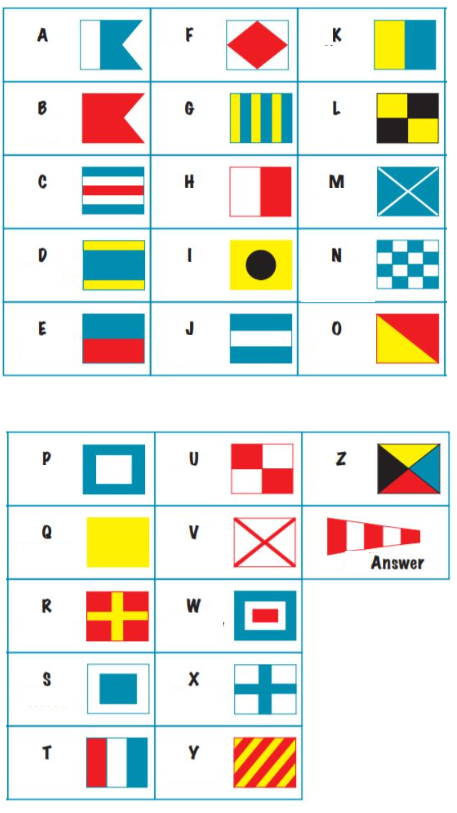
In the time before radio, boat signal flags evolved from simple identification banners into a standardized visual language that could transmit surprisingly complex messages. Back then, ships carried banners mainly to identify their ruler or country, the captain or squadron, or a merchant house or home port. Meaning depended on who displayed the flag.
Navies used flags to issue orders within fleets. An admiral might hoist a particular flag—or a flag in a particular location—ordering ships to form a line of battle, change course, engage the enemy, anchor, or get under way. Each flag or position gave one instruction. As fleets and tactics became more complicated, hundreds of possible orders were needed.
In the late 1700s, navies developed sets of numbered flags. A combination such as “1-5-4” referred to message 154 in a signal book. Navies adopted increasingly complex numerical codes allowing numbered flags for common words and phrases and, eventually, individual letters. These naval codes were secret, so the enemy could not read them, and differed among countries. Merchant vessels, in contrast, needed something international.
The British commercial code was gradually adopted, with the first truly international edition taking effect in 1901. The present International Code of Signals, or ICS, uses:
- 26 rectangular alphabet flags
- 10 triangular numeral pennants
- Three substitute pennants
- One answering pennant
Each alphabet flag has a letter value, a distinctive pattern of shapes and colors, and (except for letter R) a complete one-flag meaning. One-flag signals represent urgent or common messages. Two-flag signals give more specific information, particularly about emergencies and maneuvering. Several international flag distress signals have emerged:
N over C: International Code flags November and Charlie together mean “I am in distress and require immediate assistance.”
Square flag with a ball above or below it: A recognized distress shape combination.
Orange flag with black square and circle: Evolved mainly so distressed boats could be seen clearly from aircraft.
The American recreational boat distress flag is at least 3 feet square and carries a black square above a black circle on an orange field. It is a daytime visual-distress signal, not a general message flag. Navigation rules still recognize the NC signal, the square-and-ball arrangement and the orange identification panel among the accepted distress signals.
Nowadays ships no longer need to hoist a long coded message to report their position, cargo or destination. Flags still remain useful because they:
- Require no electricity
- Work between vessels that do not share a radio channel
- Overcome spoken-language differences
- Convey recognized conditions instantly
- Provide a visible backup when communication fails
Commercial ships mostly use a small group of practical single-letter flags. Racing sailors use a separate but related system of starting, postponement, recall and course flags. Warships still use flags ceremonially and for operational signals.
Signal flags thereby progressed through four broad stages: identity, naval orders, codebook language and emergency shorthand. Modern electronics have largely replaced them for detailed communication, but flags survive where immediate visual recognition is more valuable than conversation.
Single Letter Flag Signals
| A I have a diver down; keep well clear at slow speed. | N No |
| B I am taking in, or discharging, or carrying dangerous goods. | O Man overboard. |
| C Yes | P All persons should report on board as the vessel is about to proceed to sea. |
| D Keep clear of me; I am maneuvering with difficulty. | Q My vessel is “healthy” and I request permission to proceed into port. |
| E I am altering my course to starboard. | S I am operating astern propulsion. |
| F I am disabled; communicate with me. | T Keep clear of me; I am engaged in pair trawling. |
| G I require a pilot. When made by fishing vessels, this signal means “I am hauling nets”. | U You are running into danger. |
| H I have a pilot on board. | V I require assistance. |
| I I am altering my course to port. | W I require medical assistance. |
| J I am on fire and have dangerous cargo on board: keep well clear of me, or I am leaking dangerous cargo. | X Stop carrying out your intentions and watch for my signals. |
| K I wish to communicate with you. | Y I am dragging my anchor. |
| L You should stop your vessel instantly. | Z I require a tug. |
| M My vessel is stopped and making no way through the water. |